

Logistics operations today demand more than experience and manual coordination. Dispatch teams are expected to react in real time, manage growing fleets, and maintain delivery accuracy under changing conditions.
By 2026, the gap between traditional dispatch methods and intelligent, data-driven workflows has become impossible to ignore.
Now pause and ask a hard question.
If AI-powered systems had to be implemented today, how would your dispatch operations respond?
This is where the conversation around AI vs manual dispatching in logistics becomes very real. Not as a future idea, but as an operational decision that affects delivery efficiency, fleet coordination, and margins starting immediately.
Manual Dispatching: What Happens If You Continue Today?
Manual dispatching still exists in many logistics operations, often supported by spreadsheets, phone calls, and the experience of a few key individuals.
If you were to continue with manual dispatching today, here is what your workflow would realistically look like:
- Dispatchers rely on static route plans created hours earlier
- Sudden disruptions require human intervention and rework
- Fleet coordination depends on constant calls and messages
- Real-time routing decisions are reactive, not predictive
The challenge is not human capability. It is scale and speed.
In a high-volume environment, even the best dispatch teams struggle to adjust routes dynamically, balance loads instantly, or optimize fuel usage while meeting delivery windows.
Manual systems work until variability increases. And variability is now the default condition in logistics.
AI-Powered Logistics Dispatch Systems: What If You Deploy Today?
Now imagine deploying AI-powered logistics dispatch systems today, not next year.
Instead of static plans, dispatch becomes a living system.
Here is what changes immediately:
- Routes adjust continuously using live traffic, weather, and IoT vehicle data
- Agentic AI evaluates multiple dispatch options autonomously
- Real-time routing decisions are made before delays escalate
- Dispatchers shift from firefighting to oversight and exception handling
This is not about replacing people. It is about removing the manual burden that limits human decision-making under pressure.
The system does not wait for instructions. It anticipates outcomes and acts within defined business rules.
Scenario-Based Comparison: One Morning, Two Dispatch Models
Scenario: A Sudden Disruption
Imagine a fleet of 50 vehicles operating across urban and highway routes. A sudden environmental disruption causes delays across several corridors, similar to the kind of logistics pressure seen in dense smart cities like Dubai where traffic patterns shift quickly.
Manual Dispatch Response
- Drivers report delays individually
- Dispatchers review routes manually
- New instructions are sent one vehicle at a time
- Some deliveries miss their time windows
AI-Driven Dispatch Response
- The system detects delays via IoT signals
- Alternative routes are evaluated instantly
- Loads are redistributed automatically
- Customers receive proactive ETA updates
This is the operational difference that defines intelligent dispatch optimization workflows in 2026.
How Intelligent Dispatch Optimization Workflows Actually Work
For decision-makers, the key question is not what AI does, but how it fits into daily operations.
An intelligent dispatch workflow typically includes:
- Agentic AI orchestration that evaluates constraints and goals
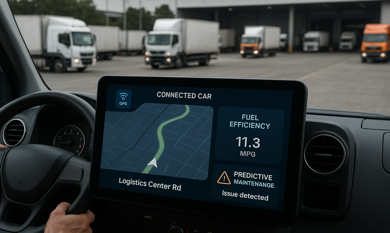
- IoT-enabled fleet visibility for location, speed, fuel, and vehicle health
- Real-time optimization engines that continuously refine routes
- Carbon-neutral routing logic that balances speed, cost, and emissions
These systems do not operate in isolation. They integrate directly with TMS, ERP, mobile driver apps, and customer dashboards.
The result is a dispatch ecosystem that adapts minute by minute.
Expert Insight: Realistic ROI from AI Dispatch Implementation
From a strategic standpoint, logistics leaders want measurable outcomes.
Based on real-world enterprise deployments in 2026, organizations implementing intelligent dispatch optimization workflows typically observe:
- 15 to 25% improvement in delivery efficiency
- 10 to 18% reduction in fuel consumption
- 30 to 40% faster response to disruptions
- Lower dispatcher burnout and error rates
The biggest gain is not cost savings alone. It is operational resilience.
When AI handles real-time routing decisions, your business is no longer vulnerable to single points of human failure.
Fleet Coordination in an AI-Driven Environment
AI transforms fleet coordination from reactive scheduling into continuous alignment.
Instead of asking, “Where is the truck now?”, the system answers:
- Where it will be in 15 minutes
- Whether it should be rerouted proactively
- Which nearby vehicle can absorb overflow
This level of coordination allows logistics managers to scale operations without scaling chaos.
Manual vs AI Dispatch: A Clear 2026 Comparison
Manual Dispatching
- Experience-driven
- Reactive to disruptions
- Limited scalability
- High dependency on individuals
AI-Driven Dispatching
- Data-driven and predictive
- Autonomous real-time adjustments
- Designed for scale
- Human oversight with machine execution
This comparison defines the real conversation around AI vs manual dispatching in logistics today.
Frequently Asked Questions
1. Can AI dispatch systems work with existing fleet software?
Yes. Modern AI-powered logistics dispatch systems are designed to integrate with existing TMS, GPS, and ERP platforms through APIs without requiring a full system replacement.
2. Will AI remove the role of dispatchers?
No. Dispatchers move into higher-value roles focused on monitoring, exception handling, and strategic decisions rather than manual coordination.
3. How quickly can AI-driven dispatch show results?
Most organizations see measurable improvements in delivery efficiency and route stability within weeks of deployment.
4. Is AI dispatch suitable for mid-sized fleets?
Absolutely. Intelligent dispatch optimization workflows scale effectively for fleets ranging from 10 vehicles to several hundred.
Conclusion: From Manual Control to Intelligent Leadership
The shift from manual to AI-driven dispatching is no longer about experimentation. In 2026, it is about leadership.
Organizations that act now gain:
- Faster decision cycles
- Stronger fleet coordination
- Predictable delivery performance
- Future-ready logistics infrastructure
For logistics leaders ready to move forward, partnering with an experienced AI development company in Dubai becomes a strategic advantage. Teams like Theta Technolabs, with deep expertise across Web, Mobile and Cloud solutions, help businesses design, deploy, and scale intelligent logistics workflows built for real-world operations.
Start Your Dispatch Strategy
Plan Your Intelligent Dispatch Transformation
If you are preparing to implement AI-driven dispatching in your logistics operations, speak with the experts at Theta Technolabs.
Our team specializes in building custom AI-powered logistics solutions that integrate seamlessly with your existing systems.
📧 Email: sales@thetatechnolabs.com Start a practical, results-focused conversation today.






_Computer%20Vision-enabled%20Web%20and%20Mobile%20Interfaces%20for%20Mall%20Management%20in%20Dubai_Q1_In_24.avif)
_Smart%20Solutions%20for%20Healthcare_%20How%20IoT%20Development%20is%20Reshaping%20Dubai%20Hospitals_Q1_In_24.avif)
_Automated%20Checkout%20Systems.avif)
_Smart%20Manufacturing%20in%20Dubai_%20How%20AI%20is%20Driving%20Efficiency%20and%20Innovation_Q1_In_24.avif)

_Understanding%20the%20Impact%20of%20AI%20and%20Machine%20Learning%20on%20Fintech%20Web%20Apps%20in%20Dubai_Q2_24.avif)
_Explore%20the%20Best%20Cross-Platform%20App%20Development%20Frameworks%20of%202024_Q3_24.avif)


_Top%20Benefits%20of%20Cloud%20Computing%20for%20All%20Business%20Sectors_Q2_24.avif)
_Integrating%20IoT%20with%20Mobile%20Apps%20for%20Advanced%20Renewable%20Energy%20Solutions_Q2_24.avif)


_The%20Transformative%20Role%20of%20Open%20Banking%20APIs%20in%20Fintech%20for%202024_Q3_24.avif)
_Choosing%20the%20Right%20Computer%20Vision%20Development%20Partner%20in%20Ahmedabad%20for%20Construction_Q3_24.avif)
_Node.js%20and%20Blockchain_%20A%20Perfect%20Pair%20for%20Fintech%20Innovation%20in%20Dubai_Q3_24.avif)
_How%20AI%20Development%20Companies%20in%20Ahmedabad%20are%20Transforming%20the%20Shopping%20Experience_Q4_25.avif)
_How%20IoT%20Can%20Reduce%20Energy%20Costs%20in%20Smart%20Factories_Q4_25.avif)
















.avif)
.avif)
.avif)





















.png)





.png)