

Imagine a large hospital network in 2026 preparing for a routine system audit. A cyberattack attempt is detected. Access logs show unusual activity, but something is different this time. No patient records are altered. No histories are deleted. No lab reports are manipulated.
Why? Because the system is built on blockchain healthcare data integrity principles.
Instead of relying on a single central database that can be quietly modified, every medical record update is logged, time-stamped, and verified across a distributed network. Any attempt to change past data is immediately visible. The breach is stopped, and trust remains intact.
This is not a futuristic fantasy. As we move toward full implementation of decentralized infrastructure in healthcare, blockchain is emerging as a practical foundation for protecting data integrity, not as a buzzword, but as working infrastructure.
In this deep dive, we explore how blockchain is strengthening healthcare data integrity systems in 2026, what problems it solves, how it works in simple terms, and what healthcare leaders should realistically expect when implementing it.
Why Traditional Healthcare Databases Are Struggling in 2026
Healthcare systems were not originally designed for today’s digital realities. Even in 2026, many hospitals still rely on architectures built a decade ago.
The Core Problems
- Data Silos Across Systems
Patient data lives in separate systems for labs, imaging, billing, insurance, and clinical notes. These systems rarely talk to each other smoothly.
- Rising Cyber Threats
Healthcare data is one of the most valuable targets on the dark web. Ransomware attacks are more sophisticated and more frequent.
- Limited Audit Transparency
Traditional logs can be edited by administrators. This makes it difficult to prove whether data was altered intentionally or accidentally.
- Compliance Pressure
Regulations around healthcare compliance now demand not just security, but proof of integrity, traceability, and accountability.
- Manual Data Exchange
Secure healthcare data sharing between hospitals, insurers, and labs still involves manual verification, delays, and repeated data entry.
In short, centralized databases were built for storage and access, not for trust at scale.
The Blockchain Solution: What If Healthcare Data Could Not Be Quietly Changed?
Understanding Blockchain in Simple Terms
At its core, blockchain is a shared digital ledger.
Every time a medical record is created or updated, the change is:
- Time-stamped
- Cryptographically signed
- Verified by multiple nodes
- Linked to previous records in a chain
Once written, the record cannot be altered without leaving a visible trace.
This is where immutable medical records come into play.
What “Immutability” Really Means
Immutability does not mean data can never be updated. It means:
- The original record is preserved
- Updates are added as new entries
- The full history remains visible
Imagine a patient diagnosis like a handwritten note that cannot be erased. You can add corrections, but the original writing is always visible underneath. Blockchain applies this principle digitally.
This creates a powerful foundation for healthcare data integrity.
How Blockchain Healthcare Data Integrity Works in Practice
Step-by-Step View
- Data Creation
A doctor enters a diagnosis or lab result into the system.
- Hash Generation
The data is converted into a unique digital fingerprint.
- Distributed Verification
Multiple authorized nodes verify the transaction.
- Block Addition
The verified data is added to the blockchain as a new block.
- Permanent Audit Trail
Every future access or update is logged transparently.
No single administrator can secretly modify records. Any attempt to tamper with data breaks the chain and triggers alerts.
Secure Healthcare Data Sharing Without Losing Control
One of the biggest misconceptions is that blockchain exposes data publicly. In reality, modern healthcare blockchains are permissioned.
How Secure Data Sharing Actually Works
- Patient data remains encrypted
- Only authorized parties can access it
- Blockchain stores proofs and permissions, not raw files
- Access rights are controlled via smart contracts
This enables secure healthcare data sharing across:
- Hospitals
- Diagnostic labs
- Insurance providers
- Government health systems
All without duplicating databases or sending files back and forth.
Blockchain Audit Trails: The Digital Fingerprint That Cannot Be Wiped Away
Every interaction with patient data leaves a trail.
Think of a blockchain audit trail like a digital fingerprint on glass. You can see who touched it, when, and how. You cannot erase it without everyone noticing.
Why This Matters for Healthcare Compliance
- Regulators can verify data integrity instantly
- Internal audits become faster and more accurate
- Disputes over record authenticity are resolved quickly
- Trust between organizations improves
In healthcare compliance, proof is as important as protection. Blockchain provides both.
A Realistic 2026 Scenario: Patient Data on the Move
From Kolkata to a National Healthcare Hub
Consider a patient who begins treatment at a hospital in Kolkata, a growing regional healthcare and health-tech hub. Months later, they relocate to another major city for advanced care.
In traditional systems:
- Records are emailed or printed
- Data is re-entered manually
- Errors creep in
- Verification takes days
With blockchain-enabled healthcare systems:
- The patient grants access via a digital consent layer
- The receiving hospital instantly verifies record authenticity
- Full medical history appears with timestamps and audit proof
- No manual paperwork is required
The data follows the patient, not the institution.
This is healthcare data integrity in action.
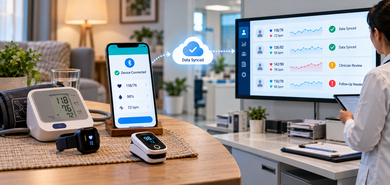
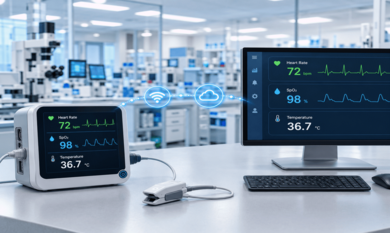
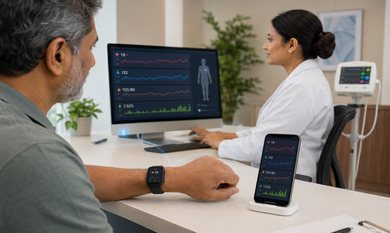
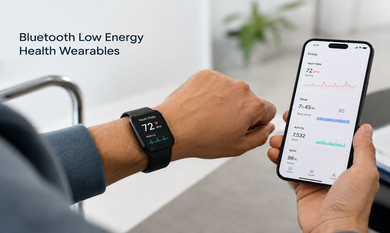
This need for integrity is even more critical in decentralized care models. For instance, in a recent telemedicine solution for remote patient monitoring, ensuring that vitals and health data transmitted from a patient's home remain untampered with is vital for accurate clinical decisions. By combining blockchain with remote care, providers can verify that the data used for diagnosis is the exact data captured by the device, creating a "gold standard" of truth for home-based recovery.
AI and Blockchain Together: The 2026 Integration Layer
Blockchain alone ensures trust. AI adds intelligence.
How They Work Together
- Blockchain guarantees data integrity
- AI analyzes trusted data for insights
- Machine learning models rely on verified records
- Predictive systems become more accurate
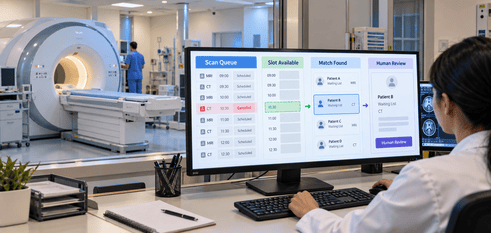
Without trusted data, AI decisions are risky. Blockchain becomes the foundation that makes AI safe to deploy in healthcare environments. In 2026, AI agents use blockchain-verified data to make autonomous scheduling and diagnostic decisions safely, knowing the source data hasn't been tampered with.
Business Benefits for Healthcare Organizations
For Hospital Networks
- Reduced risk of data breaches
- Faster compliance audits
- Improved interoperability
- Lower administrative overhead
For Insurance Providers
- Verified claims data
- Reduced fraud
- Faster claim approvals
For Patients
- Better data control
- Fewer errors
- Faster care transitions
Blockchain healthcare data integrity is not just a technical upgrade. It is an operational advantage.
Common Implementation Considerations
What Blockchain Does Not Do
- It does not replace EHR systems
- It does not store large medical images directly
- It does not eliminate the need for cybersecurity practices
What It Does Well
- Ensures data integrity
- Creates transparent audit trails
- Enables secure data exchange
- Strengthens trust across stakeholders
Implementation is about integration, not replacement.
Frequently Asked Questions
1. Is blockchain HIPAA compliant in 2026?
Blockchain itself is not a regulation, but when implemented correctly with encryption, access controls, and permissioned networks, it supports HIPAA and similar compliance frameworks by strengthening auditability and data protection.
2. How does blockchain stop data tampering?
Any change creates a new record linked to previous entries. Unauthorized changes break the chain and are immediately detectable.
3. Does blockchain slow down healthcare systems?
Modern permissioned blockchains are optimized for speed. In most implementations, performance is comparable to traditional systems with added trust benefits.
4. Who controls the data on a healthcare blockchain?
Control is shared among authorized stakeholders. Patients can be given greater visibility and consent control through smart contracts.
5. Is blockchain expensive to implement?
Costs depend on scope, but many organizations see long-term savings through reduced fraud, faster audits, and lower administrative effort.
6. Is 2026 blockchain tech energy-efficient?
Yes. Modern permissioned networks and Layer-2 solutions used in healthcare have reduced energy consumption by over 99% compared to early blockchain models. They are now as sustainable as traditional cloud databases.
Looking Ahead: The Long-Term Vision
As healthcare systems continue to digitize, trust becomes the most valuable asset.
Blockchain healthcare data integrity is not about chasing trends. It is about building infrastructure that can support:
- National health data exchanges
- AI-driven diagnostics
- Cross-border care
- Long-term patient trust
For organizations ready to lead rather than react, this shift requires specialized blockchain development services to bridge the gap between legacy systems and decentralized security. Teams like Theta Technolabs, with expertise across Web, Mobile and Cloud solutions, help healthcare providers design, integrate, and scale blockchain-based data integrity systems aligned with real operational needs.
Start Securing Healthcare Data
Connect with the consulting team at Theta Technolabs to explore how blockchain-based data integrity can be applied to your healthcare systems.
Our team works closely with healthcare organizations to design secure, compliant, and future-ready data frameworks built for real-world operations.
Reach out to us at sales@thetatechnolabs.com to begin your transformation and build healthcare systems where trust is engineered, not assumed.