


In 2026, fintech fraud is no longer random or opportunistic. It is planned, automated, and constantly adapting. Synthetic identity fraud has grown by more than 400 percent since 2022, driven by AI-generated documents, deepfake onboarding videos, and organized mule account networks.
This is exactly why agentic AI for fraud detection is becoming essential for fintech platforms. Traditional fraud tools react to predefined rules. Agentic systems work differently. They observe behavior, understand intent, and act in real time.
When we audited several legacy fraud engines last quarter, a clear pattern emerged. Rules were generating more alerts, but stopping fewer real attacks. Fraud teams were overloaded, customer friction was increasing, and compliance teams were preparing for stricter regulatory expectations in 2026.
Why Traditional Fraud Models Are Struggling
Most fintech fraud systems today still depend on static rules, isolated machine learning scores, and manual reviews. This approach worked when fraud patterns were stable. That is no longer the case.
The biggest limitation of legacy systems is lack of context. They evaluate transactions one by one, without understanding long-term behavior or connected activity.
The Shift That Matters
This is where agentic AI for fraud detection represents a major change. Instead of asking, “Does this transaction break a rule?”, agentic systems ask more useful questions:
- Does this action match how the user usually behaves?
- Is this account linked to other suspicious accounts?
- Is risk increasing over time or across channels?
This move from static rules to continuous reasoning is what separates fintech leaders from those relying on outdated controls.
The New Fraud Landscape: Faster, Smarter, and Connected
Modern fraud operates like a service. Toolkits for account takeovers, mule orchestration, and synthetic identities are easily available. Attacks adapt within hours.
In high-density fintech hubs like Delhi NCR, many platforms are seeing coordinated low-value transaction patterns tied to synthetic identities. This localized surge in sophisticated attacks is why partnering with a specialized AI development company in Delhi is becoming a strategic necessity. Each transaction looks harmless on its own, but together, they signal organized abuse that requires local context to truly dismantle.
Traditional transaction monitoring tools were never designed to detect this kind of network-level behavior. Agentic systems are.
Rule-Based Engines vs Agentic Reasoning Agents
To understand the difference clearly, it helps to compare both approaches side by side.
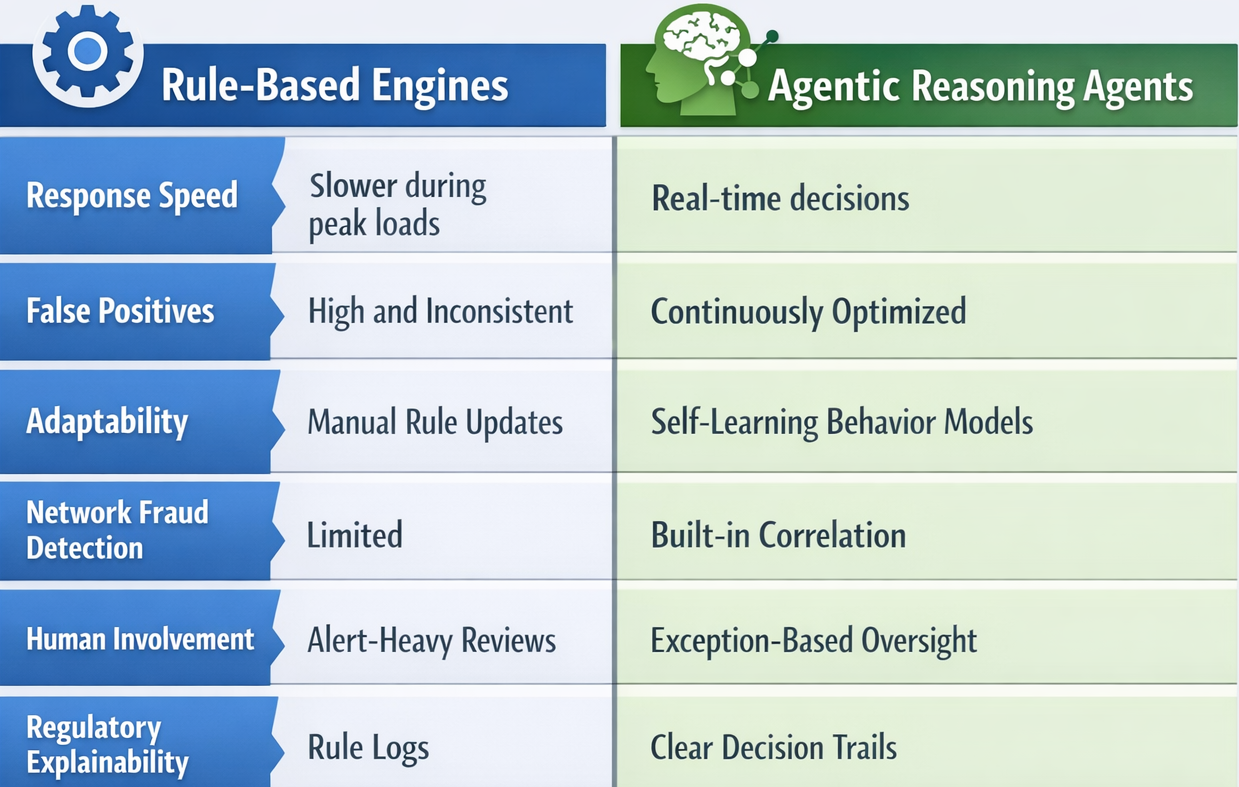
The difference is not just performance. It is how decisions are made.
From Detection Tools to Decision Platforms
Across the industry, fintech leaders are moving away from fragmented tools toward AI fraud detection systems for fintech that operate as unified decision platforms.
These systems combine transaction history, user behavior, and contextual risk signals into a single view. Instead of reacting after fraud happens, they prevent it as it develops.
Modern AI fraud detection systems for fintech are no longer judged only by detection accuracy. They are judged by how well they reduce false positives while maintaining real-time fraud alerts for genuine threats.
How Agentic Fraud Systems Work (Without the Complexity)
At a simple level, agentic systems work like digital investigators.
They are made up of specialized agents, each with a specific role.
Core Agent Functions
- Observation agents collect signals from devices, sessions, and transactions
- Reasoning agents perform behavioral risk analysis across time and accounts
- Action agents trigger responses such as step-up authentication or transaction holds
- Learning agents improve decisions through continuous machine learning loops
Together, these agents form autonomous fraud monitoring workflows that operate continuously while staying within defined governance rules.
This allows risk to be evaluated dynamically, not as a fixed score.
Why Synthetic Identity Fraud Exposes Weak Systems
Synthetic identities are not stolen. They are carefully constructed over time.
They pass KYC automation checks, build transaction history, and behave like legitimate users for months. Traditional systems fail because every interaction looks normal when viewed alone.
Agentic systems succeed because they connect behavior over time.
Signals Agentic Systems Detect
- Subtle changes in behavioral biometrics
- Shared infrastructure across different accounts
- Abnormal identity growth patterns
This approach is critical for effective account takeover prevention and mule network disruption.
Real-World Scenario: Blocking Fraud Without Slowing Users
Consider a payment aggregator managing high-volume, cross-border transactions.
The Challenge
Fraud attempts exploit timing gaps between authorization and settlement. Mule accounts move funds quickly while staying under rule thresholds. Manual reviews arrive too late.
The Agentic Response
- Observation agents detect unusual transaction sequences
- Reasoning agents correlate behavior across accounts
- Action agents isolate funds and trigger adaptive authentication
The Result
- Fraud stopped in real time
- False positives reduced significantly
- Genuine users experience smooth, uninterrupted payments
This is how reducing false positives becomes a growth advantage.
Meeting RBI’s 2026 Authentication Mandate
The RBI Authentication Directions, effective April 1, 2026, require dynamic, risk-based authentication and contextual 2FA. Static OTP enforcement is no longer enough. Read here
Agentic systems naturally support this requirement.
Why This Matters
- Low-risk transactions remain frictionless
- High-risk behavior triggers adaptive controls
- Every action is logged for audit purposes
This strengthens fintech compliance without increasing customer friction.
Explainable AI: Building Trust With Regulators
Advanced systems must still be transparent. Regulators will not accept black-box decisions.
Explainable AI ensures that agentic systems can clearly show:
- Why a decision was made
- Which factors influenced it
- When and how risk escalated
This transparency builds trust with regulators, auditors, and internal risk teams.
Operational Resilience as a Competitive Advantage
In 2026, resilience will be measured by more than uptime.
It will be measured by:
- Speed of fraud containment
- Quality of customer experience under attack
- Confidence of regulators and partners
Agentic systems turn fraud operations from reactive cost centers into strategic enablers.
Conclusion: Preparing for the Agentic Future
Fraud is already autonomous. Defending against it with static tools is no longer sustainable.
Organizations that invest in agentic AI development services will gain stronger protection, better compliance readiness, and improved customer trust.
The agentic shift is not a trend. It is the new baseline for fintech security.
Ready to Future-Proof Your Fraud Operations?
Theta Technolabs helps fintech organizations design and deploy enterprise-grade agentic fraud systems built for 2026 and beyond.
With proven expertise in Web, Mobile, and Cloud development, Theta Technolabs delivers scalable, explainable, and compliance-ready platforms tailored for modern fintech ecosystems.
If your team is planning the next phase of fraud modernization, now is the time to move from rules to intelligent reasoning.






_Computer%20Vision-enabled%20Web%20and%20Mobile%20Interfaces%20for%20Mall%20Management%20in%20Dubai_Q1_In_24.avif)
_Smart%20Solutions%20for%20Healthcare_%20How%20IoT%20Development%20is%20Reshaping%20Dubai%20Hospitals_Q1_In_24.avif)
_Automated%20Checkout%20Systems.avif)
_Smart%20Manufacturing%20in%20Dubai_%20How%20AI%20is%20Driving%20Efficiency%20and%20Innovation_Q1_In_24.avif)

_Understanding%20the%20Impact%20of%20AI%20and%20Machine%20Learning%20on%20Fintech%20Web%20Apps%20in%20Dubai_Q2_24.avif)
_Explore%20the%20Best%20Cross-Platform%20App%20Development%20Frameworks%20of%202024_Q3_24.avif)


_Top%20Benefits%20of%20Cloud%20Computing%20for%20All%20Business%20Sectors_Q2_24.avif)
_Integrating%20IoT%20with%20Mobile%20Apps%20for%20Advanced%20Renewable%20Energy%20Solutions_Q2_24.avif)


_The%20Transformative%20Role%20of%20Open%20Banking%20APIs%20in%20Fintech%20for%202024_Q3_24.avif)
_Choosing%20the%20Right%20Computer%20Vision%20Development%20Partner%20in%20Ahmedabad%20for%20Construction_Q3_24.avif)
_Node.js%20and%20Blockchain_%20A%20Perfect%20Pair%20for%20Fintech%20Innovation%20in%20Dubai_Q3_24.avif)
_How%20AI%20Development%20Companies%20in%20Ahmedabad%20are%20Transforming%20the%20Shopping%20Experience_Q4_25.avif)
_How%20IoT%20Can%20Reduce%20Energy%20Costs%20in%20Smart%20Factories_Q4_25.avif)























.avif)
.avif)
.avif)





































.png)





.png)