

In food processing and packaging, every unit leaving your facility reflects on your brand. Damaged packs, incorrect labels, leakage, weak seals, and missing batch codes are not minor issues. They lead to product rejections, customer complaints, and financial loss. Manual inspection struggles to keep pace with high-speed production lines, creating gaps in quality checks. This is where AI-powered packaging defect detection helps manufacturers address those gaps more effectively. Packaging defect detection in manufacturing is shifting from a reactive, manual process to a data-supported, consistent one.
Why Packaging Defects Are a Serious Challenge in Food Processing
Food processing plants run high-speed lines packaging thousands of units every hour. Relying solely on manual inspection creates persistent gaps. Inspectors experience fatigue over long shifts, leading to uneven checks and missed defects. Even a small percentage of defective products reaching customers can cause returns, complaints, and brand reputation damage.
Packaging defect detection in manufacturing extends beyond spotting a torn pouch. Missed defects cause rework, product wastage, and delayed shipments. Repeated quality failures affect buyer relationships and may trigger penalties from retailers or distributors. For production and quality managers, maintaining inspection accuracy at high volumes is a continuous challenge that technology can meaningfully support.
How AI-Powered Packaging Defect Detection Works
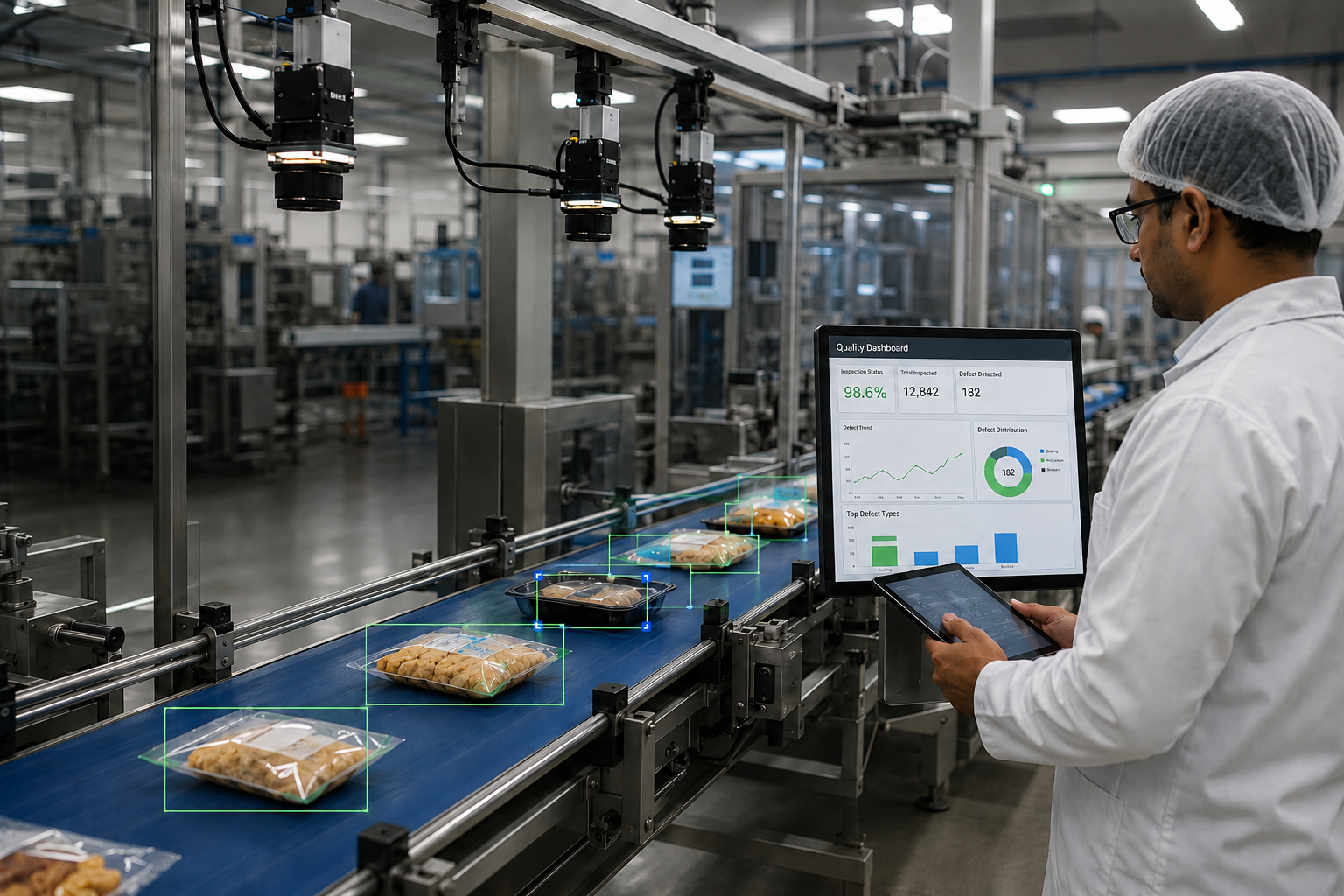
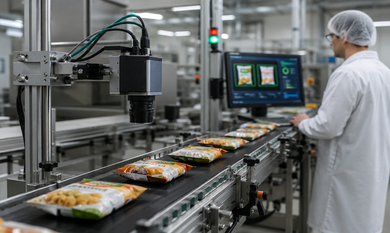
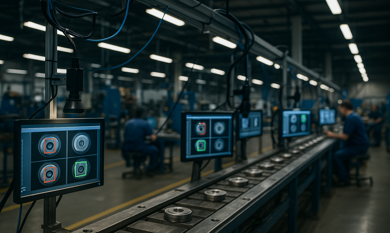
The process begins with industrial cameras positioned at key checkpoints on the packaging line. These cameras capture images of each unit in motion. Computer vision for packaging inspection then analyzes each image in real time using trained AI models.
The model learns from labeled datasets of both defect-free and defective packaging samples. When damaged product detection using AI identifies a potential issue, it flags the unit for diversion or human review. Quality teams then examine flagged items and make the final call.
Inspection data is stored and analyzed to track recurring defect patterns. Automated packaging quality inspection improves consistency across shifts while generating records that support better quality decisions.

Figure: AI-powered packaging defect detection workflow, from packaging line image capture to defect flagging and quality dashboard review.
Common Packaging Defects AI Can Detect
When properly trained and configured, AI systems can detect a range of visible packaging problems. In food environments, AI quality control in food packaging can help identify:
- Torn or damaged packaging material
- Weak or incomplete seals
- Misprinted labels or incorrect product information
- Missing batch codes or expiry dates
- Barcode and QR code errors
- Dented or crushed packaging
- Leakage marks or surface moisture signs
- Wrong product placement inside packaging
- Visible contamination indicators on outer packaging
A well-trained model with good image quality and correct camera positioning can reduce the rate of missed defects. Results depend on training data, defect variety, and your specific production environment.
Role of AI in Food Processing and Packaging Quality Control
AI in food processing and packaging is most effective when it works alongside human quality teams, not as a full replacement. Quality inspectors bring contextual judgment and decision-making ability that AI cannot fully replicate.
What AI contributes is consistency and speed. It applies the same inspection criteria to every unit without fatigue. Real-time alerts about recurring seal problems or misprinted label batches help quality teams respond faster. AI quality control in food packaging also generates structured defect records that support early identification of production-line issues.
Human oversight remains essential. AI is a supporting tool that strengthens quality processes, not a substitute for the people who manage them.
Technology Stack and Implementation Approach
Implementing visual inspection automation for packaging lines requires a structured technical approach. A practical setup includes industrial cameras, consistent lighting across all production shifts, edge or cloud processing for image analysis, trained computer vision models, a defect classification layer, a real-time quality dashboard, and ERP or production system integration for traceability.
Automated packaging quality inspection works best when the full pipeline is designed around your packaging formats and quality standards.
Companies evaluating manufacturing AI solutions in Ahmedabad should work with partners who understand both AI technology and real food processing environments, as that combination reduces implementation risk considerably.
Business Benefits for Manufacturers
When implemented correctly, AI-based inspection systems deliver practical benefits for food manufacturers.
Damaged product detection using AI helps identify problems before shipping, potentially reducing customer returns and complaints. Faster inspection cycles support throughput without compromising quality. Better batch-level traceability allows managers to investigate specific production runs more accurately.
Structured defect data also supports stronger decision-making. Real-time dashboards provide defect frequency breakdowns in place of post-shift summaries, helping identify recurring issues before they escalate.
Reduced rework, fewer returns, and stronger customer trust are realistic outcomes, though results depend on setup, defect types, data quality, and implementation planning.
Practical Limitations and What Manufacturers Should Know
AI packaging inspection is not a plug-and-play solution. It requires careful planning, proper hardware, and time to build and validate a model that performs reliably in your environment.
Image quality directly affects detection accuracy. Poor lighting, incorrect camera angles, or low-resolution captures lead to missed or false detections. The system needs sufficient labeled training images covering all expected defect categories.
Complex defects may still require human review. Models need retraining as packaging or production processes evolve. Clear defect definitions, thorough testing, and human oversight remain necessary. AI supports quality control but does not handle it independently.
Why Experience and Technical Expertise Matter
Selecting the right technology partner matters as much as choosing the right system. Computer vision for packaging inspection is a specialized field. Generic AI tools built without understanding food packaging workflows often underperform in real production settings.
An experienced partner should understand food-specific packaging defects and develop the solution using actual packaging samples from your production line. The partner should bring expertise in AI development, cloud infrastructure, system integration, and data security.
A solution built for today’s volumes should be designed to scale. Practical manufacturing experience can improve planning, model training, integration, and long-term system reliability.
Frequently Asked Questions
1. What is AI-powered packaging defect detection?
AI-powered packaging defect detection uses computer vision and machine learning to automatically inspect packaging during production. Cameras capture unit images and AI analyzes them for defects like torn material or seal failures, flagging problems for quality teams in real time.
2. Can AI completely replace manual quality inspection?
No. Automated packaging quality inspection improves consistency on high-volume repetitive tasks, but human teams remain essential for complex defects and final quality decisions.
3. Which packaging defects can AI detect in food processing?
AI quality control in food packaging can identify torn packs, weak seals, misprinted labels, missing batch codes, barcode and QR errors, dented packaging, leakage marks, and wrong product placement.
4. Is AI defect detection useful for manufacturers in Ahmedabad?
Yes. Manufacturing AI solutions in Ahmedabad can help food processing companies address inspection challenges at scale. AI can support more consistent quality control across high-volume production lines.
5. What is needed to implement AI packaging inspection?
Implementation requires industrial cameras, consistent lighting, labeled sample images, a trained computer vision for packaging inspection model, a quality dashboard, production system integration, and structured testing before going live.
Conclusion
AI can help food processing and packaging manufacturers in Ahmedabad reduce manual inspection gaps, detect damaged packaging earlier, and bring greater consistency to quality control. It works best alongside experienced quality teams.
Theta Technolabs, based in Ahmedabad, brings web, mobile, and cloud development experience alongside practical AI implementation for manufacturing environments. If you are evaluating AI consulting and development services to improve packaging quality control, our team can help you build a realistic, production-ready approach.
Ready to Improve Your Packaging Quality Control?
Theta Technolabs helps food processing and manufacturing companies in Ahmedabad build AI-powered inspection systems, quality dashboards, and integrated Web, Mobile, and Cloud solutions. Whether you are starting a quality automation project or strengthening an existing process, we are ready to discuss what is practical for your setup.
Contact us at: sales@thetatechnolabs.com




































































.png)





.png)