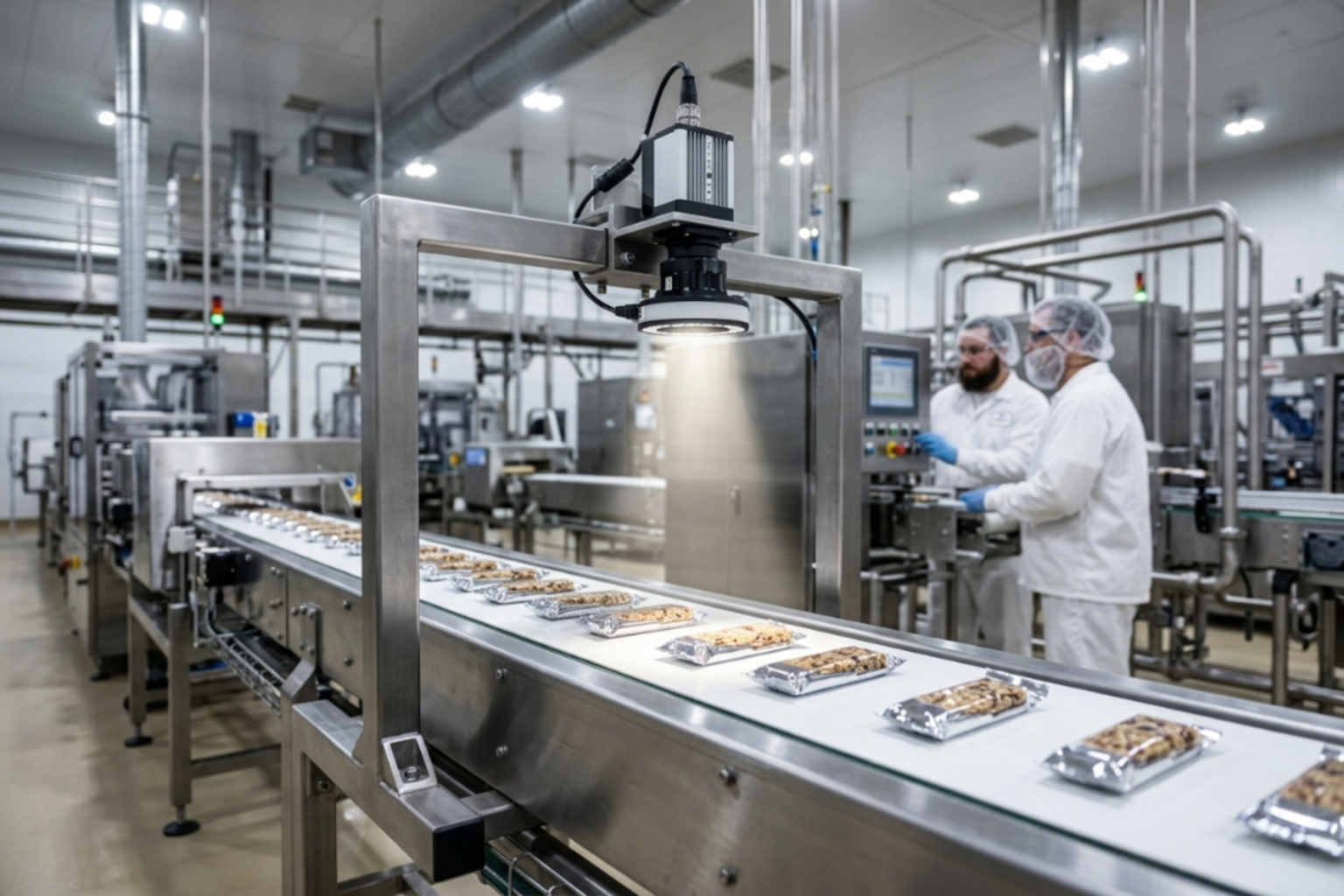


In 2026, food manufacturing operates under unprecedented scrutiny. Global supply chains are faster, regulatory standards are stricter, and consumer expectations around safety and consistency have never been higher. A single quality lapse—whether contamination, packaging defects, or inconsistent product appearance—can trigger recalls, reputational damage, and regulatory consequences.
For Quality Control Managers, Food Safety Directors, and B2B decision-makers, the traditional inspection methods that relied heavily on manual checks are increasingly insufficient. Human inspection, while valuable, struggles to maintain speed, precision, and consistency across high-volume production lines.
This is where computer vision in food quality control is transforming operations.
By combining high-speed imaging with advanced AI algorithms, manufacturers can deploy automated food inspection systems that analyze thousands of products every minute—detecting defects, verifying consistency, and ensuring compliance with food safety standards in real time.
Instead of asking why companies use computer vision, the question in 2026 is more operational:
What happens when these systems are implemented across the entire production line?
The answer is a production environment defined by precision, reliability, and scalable quality assurance.
The Shift to AI-Powered Inspection in Food Manufacturing
For decades, quality control in food manufacturing depended on manual sampling and visual inspection. Workers inspected products periodically for:
- Color consistency
- Shape irregularities
- Packaging integrity
- Visible contamination
While effective in limited cases, manual processes face inherent limitations:
- Human fatigue during long production cycles
- Inconsistent inspection accuracy
- Limited inspection speed
- Inability to inspect every unit
Modern AI-driven automated inspection systems address these challenges by integrating:
- High-speed industrial cameras
- Machine learning models
- Edge processing systems
- Production line integration
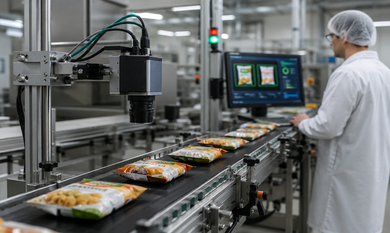
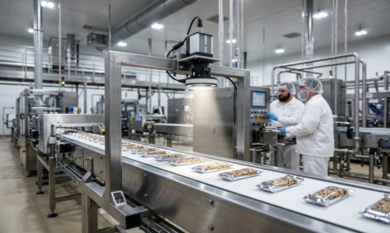
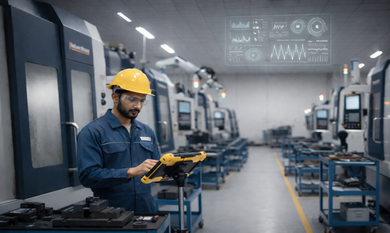
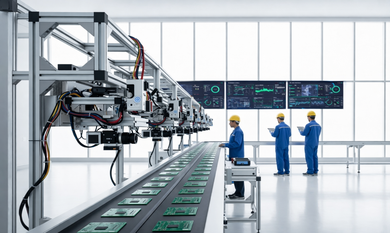
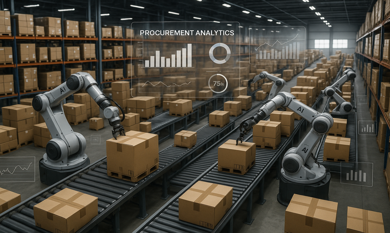
Once implemented, these systems continuously scan products on conveyor belts, instantly analyzing each item against predefined quality parameters.
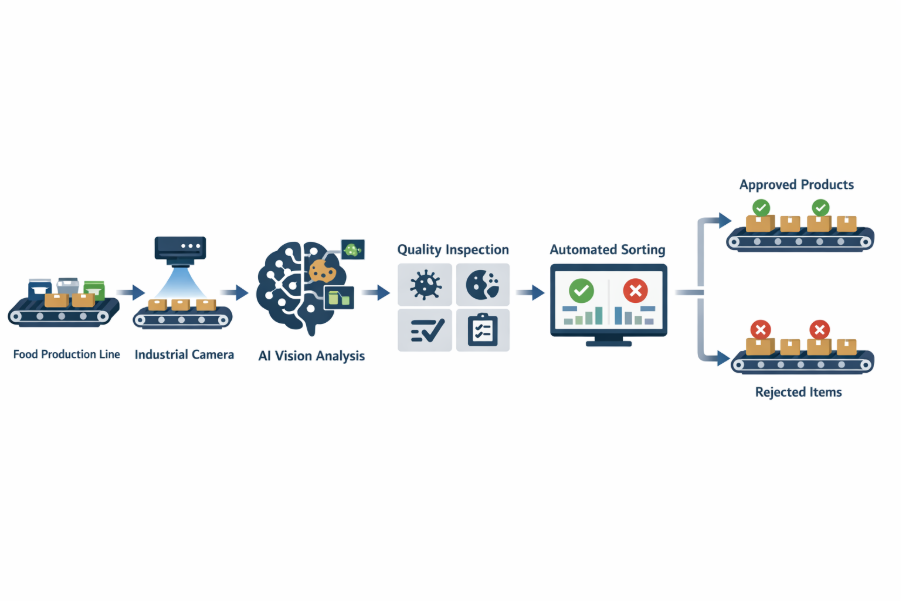
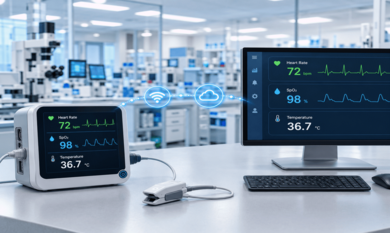
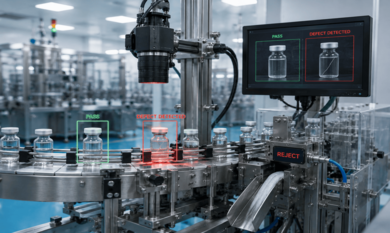
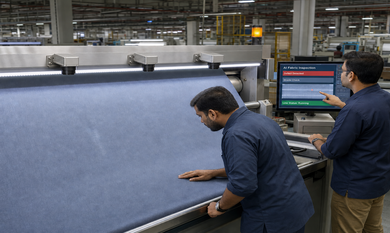
Figure: Workflow of computer vision-based automated food inspection systems in modern food manufacturing lines.
For manufacturers producing tens of thousands of units per hour, this technology shifts inspection from sampling to complete inspection coverage.
That means every product is evaluated, not just a small percentage.
How Computer Vision Improves Quality Control
1. Contamination Detection at Production Speed
Food contamination risks remain one of the most critical challenges in manufacturing.
Computer vision systems equipped with visual defect detection models can identify foreign objects such as:
- Metal fragments
- Plastic pieces
- Glass particles
- Organic contaminants
Unlike manual inspection, which relies on human eyesight, these systems analyze microscopic visual variations and pattern deviations.
Once contamination is detected, automated rejection systems immediately remove the product from the line, preventing it from reaching packaging or distribution stages.
This real-time response significantly reduces:
- Product recalls
- Regulatory penalties
- Food safety risks
Most importantly, it creates a predictable and auditable food safety workflow.
2. Consistency Checks Across High-Volume Production
Consumers expect food products to look and feel consistent—whether it's a cookie, a snack bar, or a packaged meal.
However, maintaining visual uniformity at scale is difficult.
Computer vision systems perform automated consistency checks by analyzing parameters such as:
- Color uniformity
- Product dimensions
- Shape accuracy
- Surface texture
For example, baked goods can be analyzed for:
- Over-browning
- Under-baking
- Size variation
These checks ensure that every unit meets predefined brand standards, eliminating inconsistencies that can affect customer trust.
Consistency monitoring also helps manufacturers identify upstream production issues early, preventing defects from escalating across batches.
3. Visual Defect Detection for Packaging and Product Quality
Packaging defects can compromise both product quality and safety.
AI-based visual defect detection systems can identify issues such as:
- Seal failures
- Label misalignment
- Damaged packaging
- Incorrect product placement
These issues are often difficult to detect manually at high speed.
Computer vision models analyze packaging frames in milliseconds, identifying anomalies that deviate from trained quality benchmarks.
As a result, manufacturers can achieve:
- Near-zero packaging errors
- Reduced product waste
- Improved shelf presentation
For brands competing in global markets, these improvements directly translate into higher operational efficiency and stronger brand reliability.
AI-Powered Inspection Systems in Practice
To understand the impact of implementation, consider a realistic scenario.
A large food processing plant in Pune, part of a rapidly growing food manufacturing hub, produces thousands of packaged snack units every minute.
Before implementing automation, quality inspectors manually sampled products from each production batch. While this approach worked initially, the facility began experiencing:
- Inconsistent product sizes
- Occasional color variation in baked goods
- Missed defects during peak production periods
After deploying AI-driven automated inspection systems, the production line was upgraded with:
- High-resolution industrial cameras
- Real-time image processing models
- Automated rejection mechanisms
The system began analyzing thousands of snack units per minute, performing precise visual defect detection and consistency checks.
The results were immediate:
Defect Reduction
- Subtle color inconsistencies were detected instantly
- Size variations outside tolerance levels were rejected automatically
Production Efficiency
- Inspection speed increased dramatically
- Manual inspection workload was reduced
Quality Assurance
- Every product unit was inspected rather than sampled
The plant's quality team also gained data insights from inspection logs, allowing them to identify upstream machine calibration issues before defects accumulated.
This scenario highlights the true operational value of computer vision in food quality control—not just better inspection, but smarter manufacturing decisions.
Compliance Monitoring and Food Safety Assurance
Regulatory compliance is one of the most important responsibilities in food manufacturing.
Authorities worldwide require manufacturers to maintain strict documentation and traceability of quality control procedures.
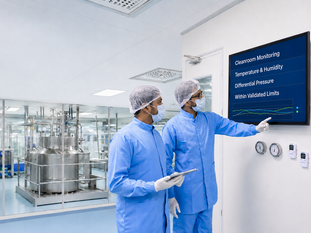
Computer vision systems enhance compliance monitoring by providing:
- Continuous inspection records
- Timestamped defect detection logs
- Visual audit trails
This means manufacturers can demonstrate 100% inspection coverage, strengthening their ability to meet food safety regulations.
More importantly, automated monitoring removes human variability from compliance workflows.
AI systems apply the same inspection criteria every time, ensuring that food safety standards are consistently enforced across production lines.
For food safety directors, this level of reliability creates confidence in operational compliance.
Frequently Asked Questions
1. What is the ROI of automated food inspection systems?
ROI typically comes from reduced waste, fewer recalls, and improved operational efficiency. Many manufacturers also save costs by reducing manual inspection labor and minimizing production downtime caused by defect-related investigations.
2. Are AI inspection systems accurate enough for food safety?
Yes. Modern computer vision systems can achieve extremely high accuracy rates, especially when trained with production-specific datasets. They detect visual anomalies that human inspectors may miss during high-speed operations.
3. Can computer vision inspect multiple product types?
Yes. Advanced systems can be trained for multiple SKUs and product formats, allowing manufacturers to switch inspection models as production lines change.
4. Is integration with existing production lines difficult?
Most modern automated food inspection systems are designed for modular integration, meaning they can be installed alongside existing conveyors and packaging systems with minimal disruption.
Conclusion
In 2026, quality control is no longer just about detecting defects—it's about preventing them through intelligent systems.
The implementation of computer vision in food quality control enables manufacturers to move beyond manual sampling toward complete production visibility.
With capabilities such as:
- contamination detection
- consistency checks
- visual defect detection
- compliance monitoring
AI-powered inspection is becoming a core infrastructure for modern food manufacturing.
Organizations looking to adopt this technology often collaborate with a specialized computer vision development company capable of designing scalable inspection solutions.
Companies like Theta Technolabs bring deep expertise in Web, Mobile, and Cloud technologies, enabling food manufacturers to deploy intelligent inspection systems that integrate seamlessly with modern digital production environments.
As food manufacturing continues evolving, computer vision will play a critical role in ensuring safer products, stronger compliance, and smarter production workflows.
Strengthen Food Safety Inspection Systems
If you're exploring how computer vision and AI-driven inspection systems can elevate quality control in your food manufacturing operations, expert guidance can accelerate your journey.
Theta Technolabs helps manufacturers design and deploy intelligent inspection platforms tailored for real-world production environments.
📩 Reach out for a consultation: sales@thetatechnolabs.com
Discover how AI-powered inspection can help your production lines achieve unmatched accuracy, compliance, and efficiency.